In case anyone reads this on Hacker News, firstly allow me to apologise for the inconsistent gravity, and the consistency errors in general throughout the video! I hope you can forgive me and that you enjoy the film anyway :-)
Creating this film was a surprisingly profound experience for me. I am aphantasic and cannot visualise things in my mind. So it's an emotional rollercoater seeing my ideas come to life visually like this. I teared up when I saw the video come together.
How it was made
Every shot in the film was generated by AI on my home PC with an NVIDIA RTX 5090. I made the ships using an image generation model, Krea2, and supplied some reference photos of my family. A local model did the rest.
The model
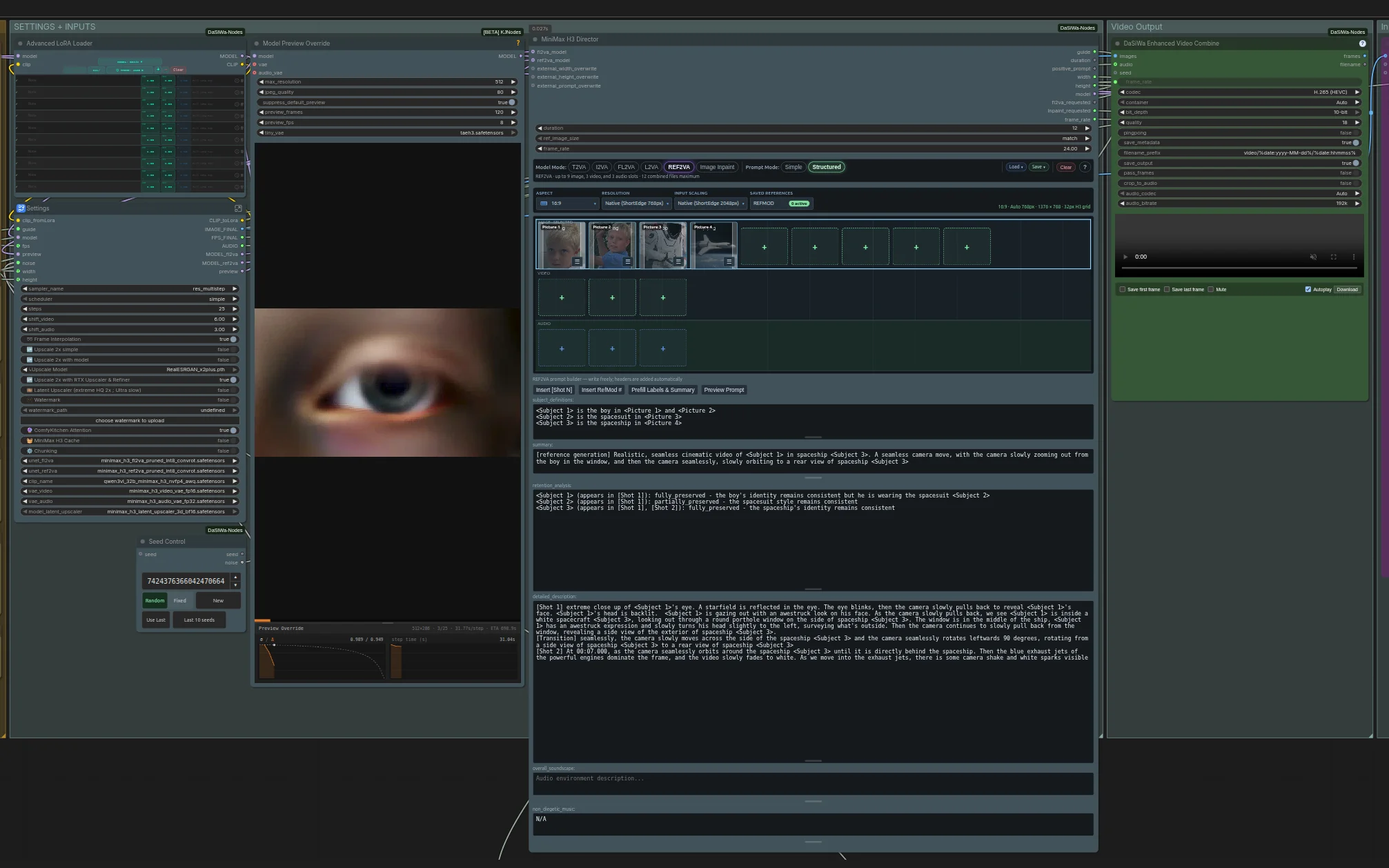
The video model is MiniMax H3, run locally in its reference-to-video mode (REF2VA). Rather than starting from a text prompt alone, each shot is built from a set of reference pictures: photos of the family, plus images of the spaceship, the cockpit, the cabin, the spacesuit and Freddie's toy giraffe. The prompt then says which picture is which subject, for example "Subject 1 is the 7 year old boy in Pictures 1, 2 and 3", and describes the action shot by shot. The model keeps those people and objects recognisable across the whole clip. Aside from learning the AI tech, this was also an education in Hollywood terminology e.g. "the camera trucks right, pedestal down at low amplitude," as this is the language Minimax is trained to accept.
The workflow
- ComfyUI runs the generation, using a workflow adapted from the community DaSiWa MiniMax H3 workflow, with one saved workflow per scene.
- Each clip is generated at 1376×768 and 24 fps (25 sampling steps,
res_multistepsampler), with a Qwen3-VL 32B text encoder reading the prompt. - It is then upscaled 1.5× to 2080×1152 with NVIDIA RTX Video Super Resolution, and frame-interpolated to 48 fps with FILM.
- A 12-second clip takes about 10 minutes to render on the RTX 5090.
- Each shot took several attempts. I rendered variations, reviewed them, and kept the best take of each scene. In some cases I captured screenshots of frames I liked, made edits in GIMP (e.g. moving the spaceships further apart, and lengthening the exhaust trails), and then used those edited images as storyboard reference images for the next take.
Electricity
Generating the whole film, including every take I threw away, took about 32 hours of rendering and roughly 23.5 kWh of electricity (about 0.1 kWh per take). The house has solar panels and a battery, and I'm on Intelligent Octopus (30p peak, 7p off-peak per kWh), so the cost depends on where each minute's power came from:
| Source | kWh | Cost |
|---|---|---|
| Grid (almost all at the 30p peak rate) | 15.0 | £4.49 |
| Solar that would otherwise have been exported | 4.1 | £0.61 |
| Home battery (refilled at the 7p off-peak rate) | 4.4 | £0.34 |
| Total | 23.5 | ≈ £5.44 |
Estimated from the PC's measured GPU and CPU power plus an allowance for the rest of the machine, matched minute by minute against the house's solar, battery and tariff data.
The edit
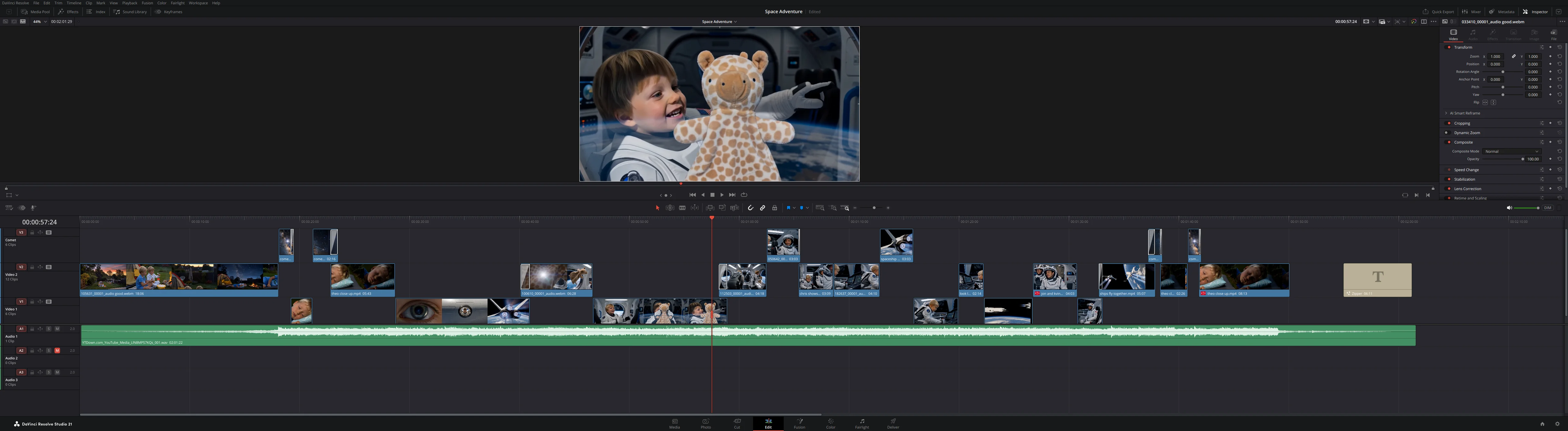
The clips were cut together in DaVinci Resolve Studio on a 48 fps timeline and set to music: Snowfall by Øneheart and reidenshi.
Tools
- MiniMax H3 (video generation)
- ComfyUI (generation workflow)
- DaVinci Resolve Studio 21 (editing)
- FFmpeg (encoding for the web)
- Ubuntu Linux with an NVIDIA RTX 5090